The state worth protecting
Mihaly Csikszentmihalyi's research on flow described something developers already know in their bodies: there is a zone where time vanishes, action becomes effortless, and a tangled problem quietly comes apart in your hands. It is where the best code gets written, and it is also delicate. It takes time to enter, and almost no time to lose.
Quick Answer
You measure flow state without breaking it by measuring it passively, after the fact, from the artifacts your work already produces. Flow is the deep, absorbed state where time disappears and code comes easily, and it is fragile: timers, check-ins, and pop-up prompts destroy the very state they try to record. The fix is to stop interrupting and instead reconstruct your sessions from commits, saves, and editor activity once the work is done. That way the measurement never touches the flow. Below is why active tracking is self-defeating and how passive measurement actually works.
Flow sessions share a recognisable set of traits. Time awareness drops away, action and attention merge, the work feels automatic rather than effortful, and you are completely absorbed in the task. The common thread is that none of these survive being interrupted. The moment something pulls your attention out to answer a question, even a small one, the state is gone and the climb back in starts over.
That fragility is the whole problem with measuring it, and it is why most productivity tracking quietly makes flow worse rather than helping you protect it.
The measurement paradox
Here is the trap. Traditional productivity tracking, timers you start and stop, periodic check-ins, prompts asking what you are working on, actively disrupts the state it is trying to capture. It is like studying sleep by waking someone every ten minutes to ask whether they are asleep. The act of measuring destroys the thing being measured.
For flow this is not a minor side effect, it is disqualifying. Any system that requires your attention to record your work is, by definition, pulling you out of the absorption that defines flow. You cannot stay in the zone and tend a timer at the same time. So the more diligently you track flow with active tools, the less flow you actually get, and the data you collect is of the fragmented work the tracking itself created. The measurement does not just observe the system, it damages it.
This is the reframe that matters: if a tool needs you to participate in the measurement, it is the wrong tool for measuring deep work. The only honest way to measure flow is to not touch it while it happens.
Passive measurement: how it actually works
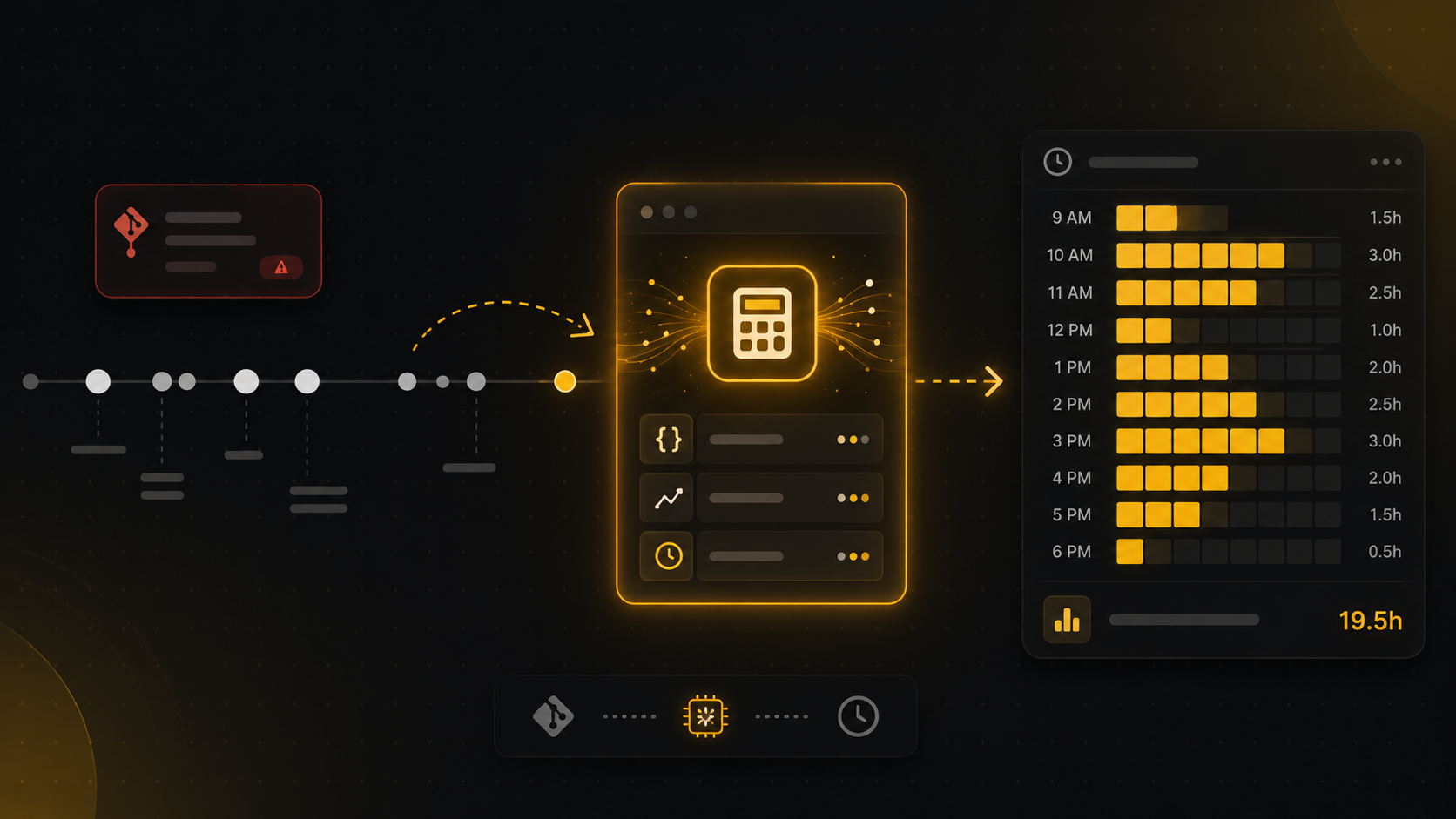
The alternative is to observe the artifacts of the work rather than interrupting the worker. As you code, you leave a trail: commits, file saves, and editor and terminal activity, all timestamped. A passive tool reads that trail afterward and reconstructs your sessions from it, so the measurement happens entirely after the fact and never intrudes on the work.
In practice this means there is nothing to start, nothing to remember, no prompt to dismiss, and no guilt about forgetting to track. The data reflects how you actually coded rather than how dutifully you managed a timer. It is the same principle behind accurate time tracking generally, which is that the honest signal is the work itself, not your real-time reporting of it. See how to track coding time from git for the underlying mechanism and why manual timesheets lie for why the active alternative fails.
What flow looks like in the data
Once you measure passively, flow becomes visible without ever having been disturbed. In a reconstructed view of your work, deep sessions stand out as long, unbroken stretches where activity is steady and the changes are cohesive, one piece of work being carried through rather than a scatter of unrelated edits. Fragmented days look different: short bursts, frequent gaps, context scattered across many places.
Seeing the contrast is the point. When you can identify when your real flow sessions happen, what time of day, what conditions, you can build your schedule to protect those windows instead of letting them get chewed up by meetings and pings. The measurement earns its keep precisely because it did not cost you any flow to collect. This is also where it connects to the real cost of context switching: you cannot protect deep work you cannot see.
Where DevClocked fits
DevClocked is built around passive measurement. It reconstructs your sessions from commits, saves, and editor and terminal activity, so it shows you when you hit deep work without ever interrupting it, and it captures AI and terminal sessions that active tools tend to miss. If your goal is to find and protect your best focus windows, that is exactly the kind of after-the-fact view it produces.
It is worth being honest about what it is not. It will not babysit your focus for you, block your notifications, or force the discipline, that part is on you and your calendar. And if you want subjective signals like mood or energy alongside the activity data, that takes a separate journaling habit a passive tracker does not replace. DevClocked earns its place when you want an honest picture of your deep-work patterns that the measuring itself did not distort.
Related Guides
- The real cost of context switching: why protecting flow windows is worth so much.
- How to track coding time from git: the passive measurement mechanism.
- Why manual timesheets lie: why active, memory-based tracking fails.
- 9 best time tracking tools for developers: passive versus active tools compared.